)
)
)
Meet the Speaker Q&A: Antoine Scalia, Founder and CEO, Cryptio
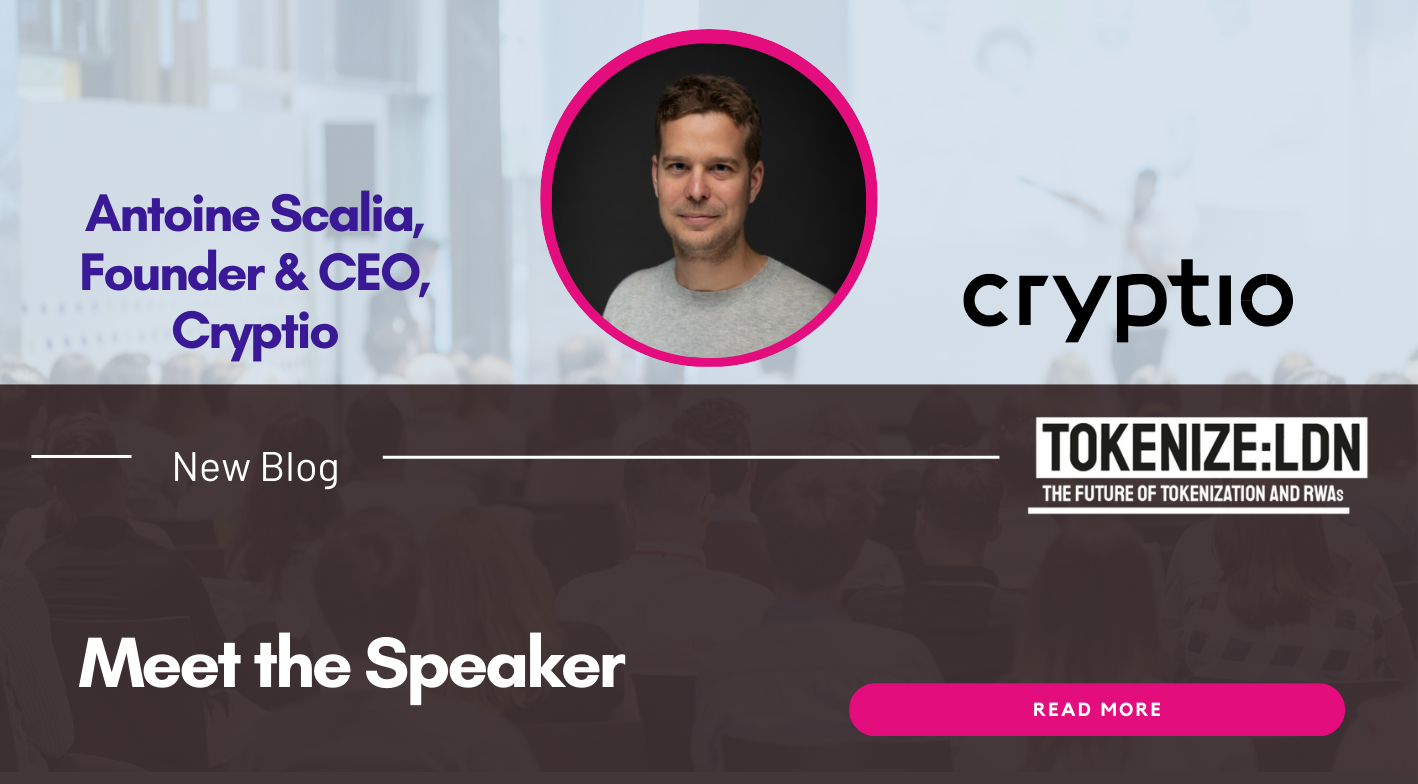
Ahead of his appearance at Tokenize: LDN, on December 2-3, Antoine Scalia, founder and CEO at Cryptio, talks about Cryptio’s journey from crypto accounting sub-ledger to enterprise-grade platform, the shift towards verifiable infrastructure in crypto, and what 2026 will hold for the industry.
---
Hi, Antoine. Tell us about your career to date, how Cryptio came to be founded, and the problem you are trying to solve in this space?
I began my career across product, data, and venture in Europe and the U.S., working with tech founders and finance teams. In 2018, I started Cryptio to tackle a foundational gap we saw as digital assets moved into regulated finance: enterprises needed a reliable way to transform fragmented on-chain and exchange activity into auditable financial records and controls. That required purpose-built data infrastructure, reconciliation engines, and reporting workflows that align crypto with the standards finance leaders, auditors, and regulators expect.
Seven years later, Cryptio supports 450+ institutions and enterprises, including Circle, Gemini, Uniswap - providing an enterprise-grade back office and data platform, with SOC-compliant infrastructure and workflows for accounting, audit, loan management, and tokenization compliance.
Cryptio’s suite of ERP applications solve the most complex problems for regulated financial institutions:
- Token issuer compliance (liability reporting)
- Accounting and reporting for digital assets issuers
- Loan management system
How have you assessed 2025 in crypto - both in terms of the wider space and what it means for Cryptio's mission?
2025 marked the maturation of institutional digital asset rails. Banks, brokers, and fintechs are rolling out products under clearer regulatory frameworks; stablecoins and tokenized instruments are moving into payments and settlement; and lending and structured products have re-emerged under stricter governance. The theme is convergence: capital markets are moving on-chain, but the operational complexity multiplies with every new business line.
For our mission - bringing financial integrity to digital assets - this means two things:
- Depth of controls and auditability are now competitive advantages, not checkboxes.
- Independent, cross-system reconciliation is essential for trust, licensing, and IPO readiness.
This is why we shifted Cryptio into a multi-application platform uniting Accounting, Tokenization Compliance, and Loan Management on a single trusted data layer.
Could you summarise the most recent platform updates for Cryptio, as you announced at the Crypto Finance Forum, and what this means for clients?
At CFF 2025 we unveiled Cryptio as a multi-application platform built on one data layer, with three pillars:
- Accounting: segregation of co-mingled activities reporting, mark-to-market, and unrealized P&L for derivatives and multi-dimensional reporting.
- Tokenization Compliance: independent, audit-ready token supply reconciliation across chains and internal systems for stablecoins and RWAs
- Loan Management: institutional-grade workflows across front, middle, and back office for crypto-backed credit portfolios
What this means for clients:
- One data source of truth across business lines
- Unlocking accounting capabilities for OTC desks, brokers, atm flows and options trading
- establish institutional confidence with independently verified token supply data and reconciliation
- scale crypto lending business with financial integrity
How has the journey progressed to building a multi-application platform?
We’ve evolved from a crypto accounting sub-ledger into a platform that unifies the core operational controls regulated enterprises need. That journey includes our Bedrock data layer for performance and scale, the AutoRec reconciliation engine for movement and balance-level assurance, and application modules for Accounting, Tokenization Compliance, and Loan Management. The through-line is the same: rigorous reconciliation and auditability at institutional scale.
The multi-application shift reduces duplicated data work, lowers change risk, and lets finance, risk, and compliance teams operate from one source of truth — critical for brokers, banks, fintechs, and token issuers launching new products.
Was this always the goal, or did industry moves alter the plan?
The north star never changed — building financial integrity for digital assets. What evolved was the industry around us. As stablecoins, DeFi, and later regulated custodial products took off, it became clear that accounting alone wasn’t enough. Institutions needed the same controls they expect in TradFi: independent reconciliation across on-chain activity, custodians, trading systems, and internal ledgers, and they needed this not just for accounting, but also for token programs and credit businesses.
These shifts accelerated our move from a single application to a platform. We invested first in the data and reconciliation layer the foundations behind Ionic and Colossal (previous generations) and then expanded into the areas where independence and auditability matter most: Tokenization Compliance and Loan Management.
The goal stayed the same; the industry simply made the path obvious.
What innovations are you most excited by at the moment and what innovation still needs to be unlocked in the industry in your opinion?
I’m most excited by the shift toward verifiable infrastructure in crypto. We’re finally seeing tokenized products, stablecoins, and on-chain financial primitives adopt the kind of independent controls that institutions rely on in traditional markets. Automated, cross-chain supply assurance, compliance-as-code, and unified data backbones are starting to replace spreadsheets and manual checks. It’s a real step toward making on-chain finance audit-ready by default — not by exception.
What still needs to be unlocked is the institutional layer around all of this. We need standardized risk and audit frameworks across jurisdictions, deeper programmatic attestations for issuers, and ERP-grade automation for global, multi-entity organizations. The technology is there; now the industry has to converge on shared standards so regulated institutions can scale without reinventing the wheel each time.
What will you be speaking about at Tokenize and what do you think the key discussion topics will be on the show floor? What are the key questions that delegates will want answering?
Based on our recent keynote themes and the audience’s RWA focus, I’ll cover:
- How to operationalize tokenization programs: from smart-contract issuance to independent supply reconciliation, approvals, and reporting to meet MiCA, U.S. guidance, and exchange-listing standards
- Why independent, cross-system reconciliation is the linchpin for trust, licensing, and market access
- Case-patterns from stablecoin and RWA issuers where segregation of funds, multi-chain coverage, and auditor-ready trails mattered most
I think the likely topics on the floor will include...
- Practical compliance for tokenized treasuries, credit, and funds
- Getting from pilot to production under global rules
- Build vs buy for back-office infrastructure as programs scale
... while the key questions delegates will want answered I think are:
- How do we prove 1:1 token liabilities and reserves across chains, custodians, and internal systems independently and at scale?
- How quickly can we stand up compliant reporting and approval workflows to support licensing or listings?
- What does “audit-ready” actually mean for tokenization, and what evidence do auditors expect?
- How do we manage segregation of pre-mint inventories?
What can we expect from Cryptio in 2026 in terms of general roadmap?
- Tokenization Compliance expansion: broader chain coverage, deeper attestation workflows, and richer, jurisdiction-specific report packs to accelerate licensing and exchange acceptance
- Accounting and ERP: upgraded ERP integration with multi-entity and classification mapping improvements, plus reporting packages for treasury and token issuers
- Loan Management: expanded risk views, stress testing, and collateral flows integrated with reconciliation and audit trails
- Data layer and reconciliation: continued performance scaling, coverage growth, and resilience to API/contract changes, to keep audit confidence high even at extreme volumes